
Press Releases
-
Reviews
An Intimate, Thoroughly Chilling Bluebeard
November 8, 2021 | By Clive Paget, Musical America
LONDON--In opera, directorial “concepts” can sometimes be frustrating, distorting or even overwhelming a composer’s intentions. That Daisy Evans’s powerful re-imagining of Bartók’s Bluebeard’s Castle as an exploration of a couple wrestling with dementia works so completely is a testament to both the director’s assured reading of the text and the conviction of Gerald Finley and Susan Bullock in bringing it convincingly to life. The production, seen on November 6, is staged by the newly formed Theatre of Sound in the intimate yet imposing ambience of Stone Nest, a former Presbyterian church (and in the 1980s, home of the hedonistic Limelight nightclub) in the heart of London's West End.
Béla Balázs’s libretto for Bartók’s 1911 opera is based on Charles Perrault’s famous 17th-century tale of a wife-murdering French duke. But Balázs was essentially a Symbolist poet, more interested in exploring the inner lives and buried memories of Bluebeard and his latest wife Judith. In traditional stagings, Judith confronts her fears and the rumors about her husband’s former life through a determined questioning that pries open the past to disastrous effect. In Bluebeard’s mysterious castle, the last of seven doors is opened to reveal three former wives—a rollcall that Judith is then compelled to join. But Bartók was clear that his Bluebeard was no murderer. His opera, he maintained, was an allegory in which a lonely man must come to terms with previous loves that live on only as memory.
Memory is thus where Evans begins. Finley’s Bluebeard—he uses the name with a ruefully irony—is a man whose wife is suffering from symptoms of advancing dementia. Their musty home is a full of old photos and faded furniture, surrounded by a plethora of lamps that flash, flicker, and fade like the damaged synapses inside a deteriorating brain. We discover him stowing a solitary photo in an old trunk before leaving to reappear with Bullock, a fragile woman clearly confused by her surroundings. In attempting to reorient his wife, Finley will have to dig up the past and relive events he’d hoped to bury forever.
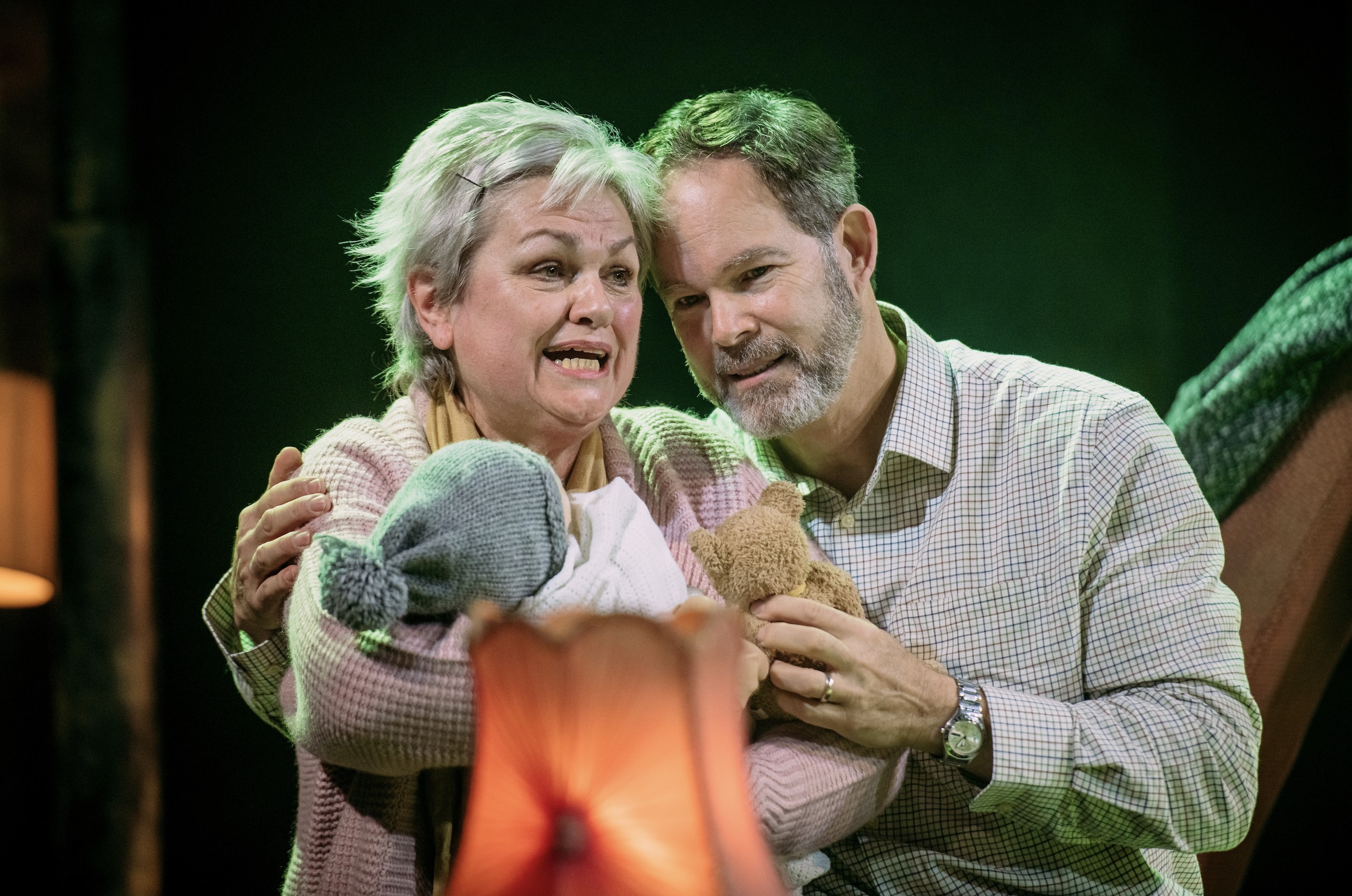
Susan Bullock and Gerald Finley in a reimagined Bluebeard
Moments from their life together are triggered by items taken out of the trunk—a military great coat, a bridal veil, a child’s toy, etc. Cleverly, each of these seven objects is a parallel for one of Bluebeard’s seven doors. Bit by bit, a shared life story is revealed, from courtship and marriage to childbirth and the tragic death of a son. Each reminiscence is accompanied by the appearance of one of three actors who represent Bullock at important moments in her life. As she stares confusedly into the eyes of her avatars, a series of tiny, mirrored gestures convey their mutual affinities.
Pieces of memory
Evans’s contemporary echoes of the visions behind each of Bartók’s doors are deftly chosen. The greatcoat represents the armory, for example, here symbolizing Bullock’s young husband going off to war; the veil, which reflects Bluebeard’s treasury, stands for Bullock on her wedding day; the garden suggests fertility and a first baby. The grandiose fifth door, which traditionally reveals the extent of Bluebeard’s kingdom, here becomes a happy family Christmas complete with Santa hats and a pair of boisterous children.
The sixth door—originally called the pool of tears—finds Bullock wrestling with a parcel wrapped in black crepe paper from which spills a collection of birthday cards and other memorabilia, including a memorial sheet for the couple’s dead son. The final object is a mirror. As Finley invites Bullock to gaze into its depths, her other selves join her. For this family, however, there can be no meaningful future, and Finley must wearily close the trunk of memories forever.
It's powerful stuff, powerfully played. Finley conveys Bluebeard’s outer concern and inner conflicts in a skillfully drawn portrait of a man who revisits his own traumatic past only to realize the futility of trying to help a wife who is destined to become just one more painful memory. Bullock makes a touching, bewildered Judith, her haunted expressions frightened and despairing by turns. Finley especially is in superb voice, his flawless baritone ringing out in the resonant yet grateful acoustic of this domed former chapel. He brings every ounce of experience as one of today’s finest Lieder singers to his penetrating interrogation of the text in Evans’s effective new English translation. Bullock offers slightly less vocal color, but her diction is commendable and she can still summon a ringing high C to accompany the famous C-major opening of the fifth door.
New orchestrations
The score is played in Stephen Higgins’s new orchestrations by eight members of the London Sinfonietta. With only a string quartet, two clarinets, horn, and a keyboard (alternating piano, organ, and celesta), there’s inevitably a degree of color lacking, especially where Bartók calls for tuned percussion, flutes, and harp. The result is a little monochrome, though by eschewing piccolos and trumpets it’s often darkly effective. Higgins conducts, the pacing assured, though his reading could benefit from greater dynamic light and shade.
What makes this staging especially intense is the privilege of hearing world-class singers up close and personal (at one point I had to shift my foot so that Finley wouldn’t step on it). With audience on three sides, and the added gloomy ambience of Stone Nest’s lofty vault, this is opera at its most immersive and atmospheric.
Classical music coverage on Musical America is supported in part by a grant from the Rubin Institute for Music Criticism, the San Francisco Conservatory of Music, and the Ann and Gordon Getty Foundation. Musical America makes all editorial decisions.

